
The Admiral
Ask in Slack. Every answer shows its work.
The Admiral answers questions about your business in the channel your team is already in, and shows you the approved definition and the query behind the number.
Get The Admiral in your Slack See it get audited
The Admiral comes with the Data OS. It reads the same governed tables your dashboards read.
Your data warehouse
In an account you own, so the number has somewhere to come from.
Your people
In the channel where the decision is already happening.
Your governance
Approved definitions, so the answer does not move when nobody changed the business.
Anyone can audit it
Ask it how it got there. It shows you the query.
This is the exchange that makes the rest of the page believable. Question a number and you do not get reassurance. You get the approved definition, the SQL behind it, the table it read, and the table it deliberately did not.
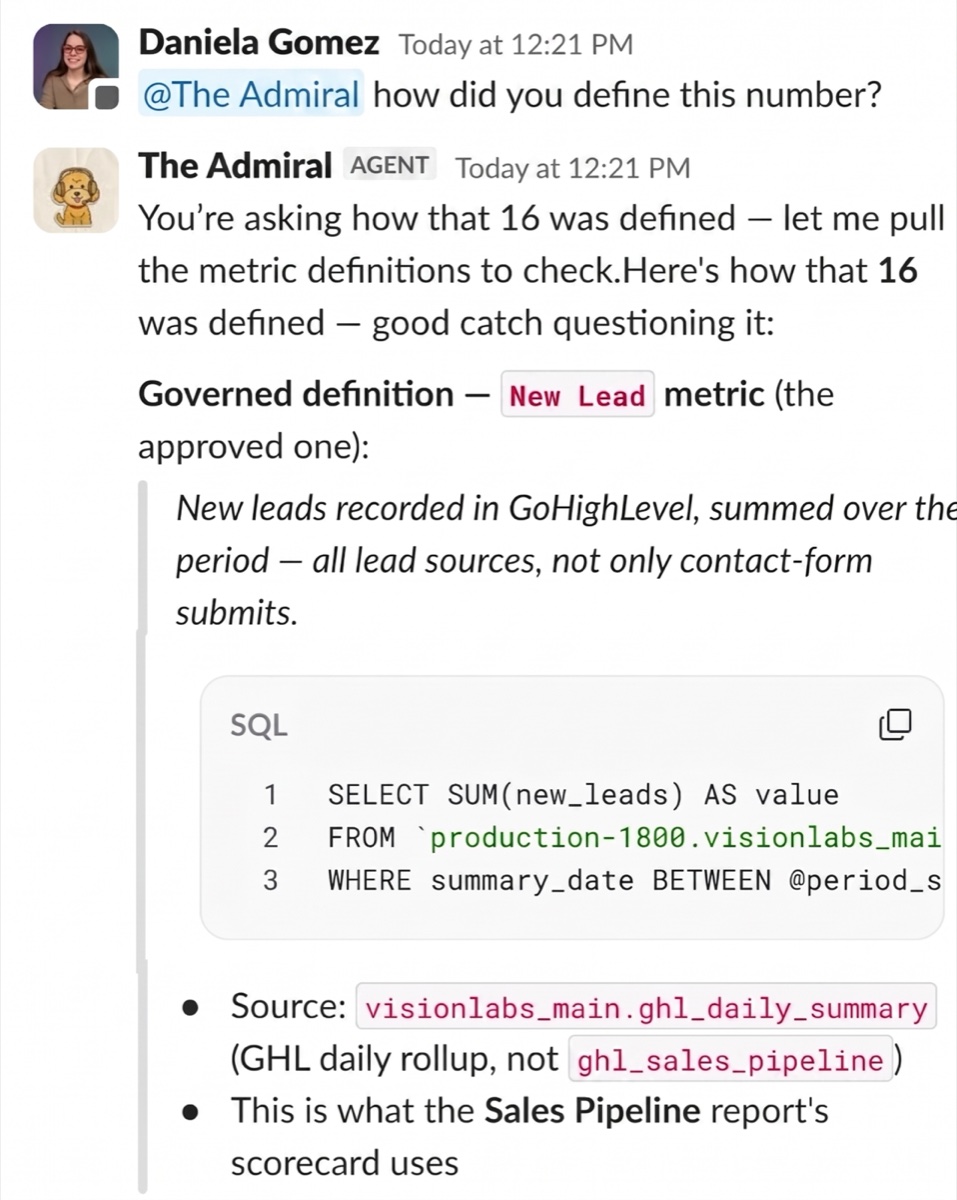
Note what the last line rules out. Two tables could plausibly answer "how many leads" and they disagree. The Admiral names which one is governed for this metric, which is the difference between an answer and a coincidence.
It writes, not just reads
Settle a definition once. Everyone inherits it.
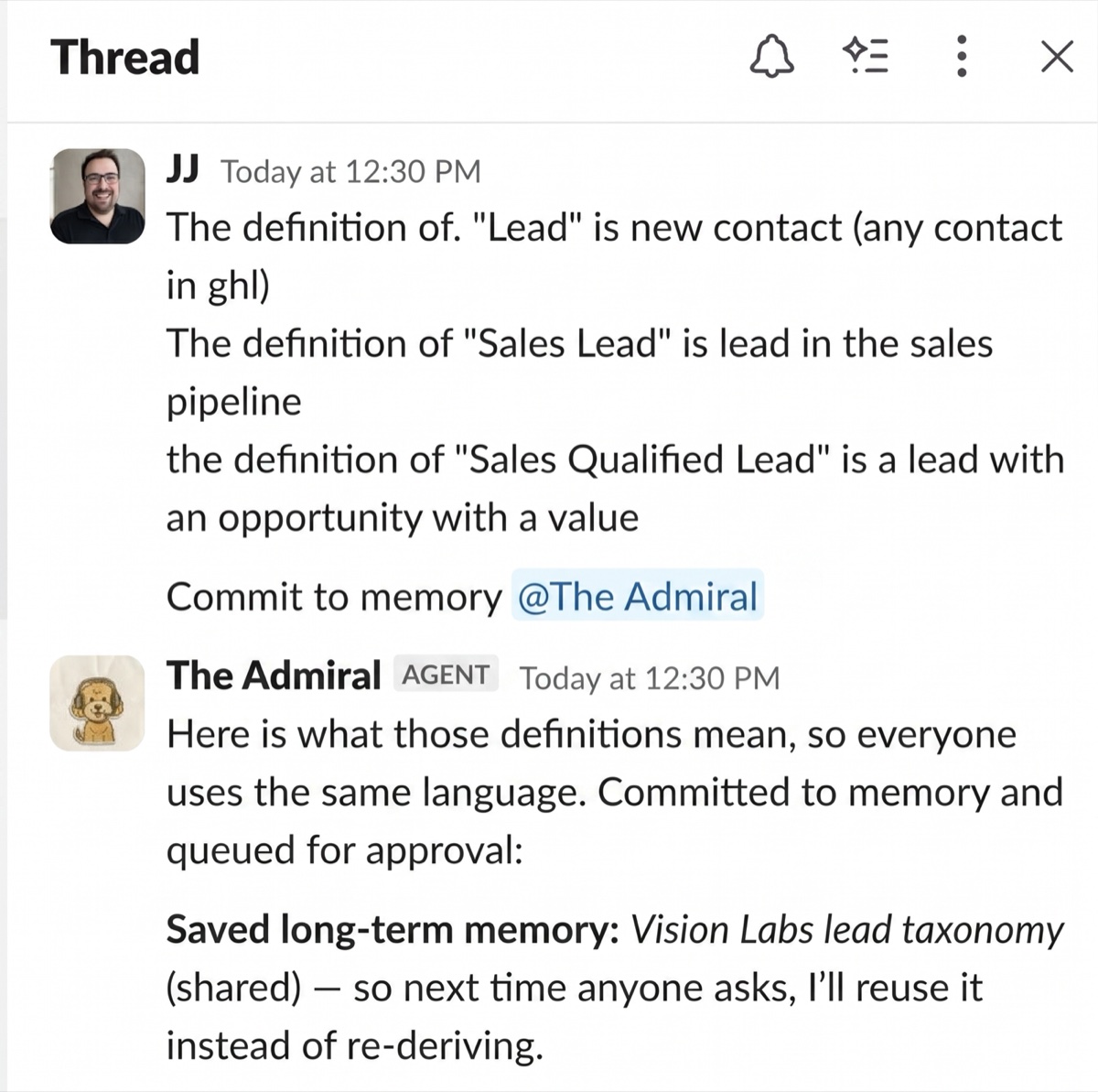
Other agents automate tasks. The Admiral edits the thing underneath the tasks: the definitions every report, dashboard and answer is built on. Nobody has to remember to tell the next person, and the argument does not happen again in three weeks.
The approval step is the whole trust argument
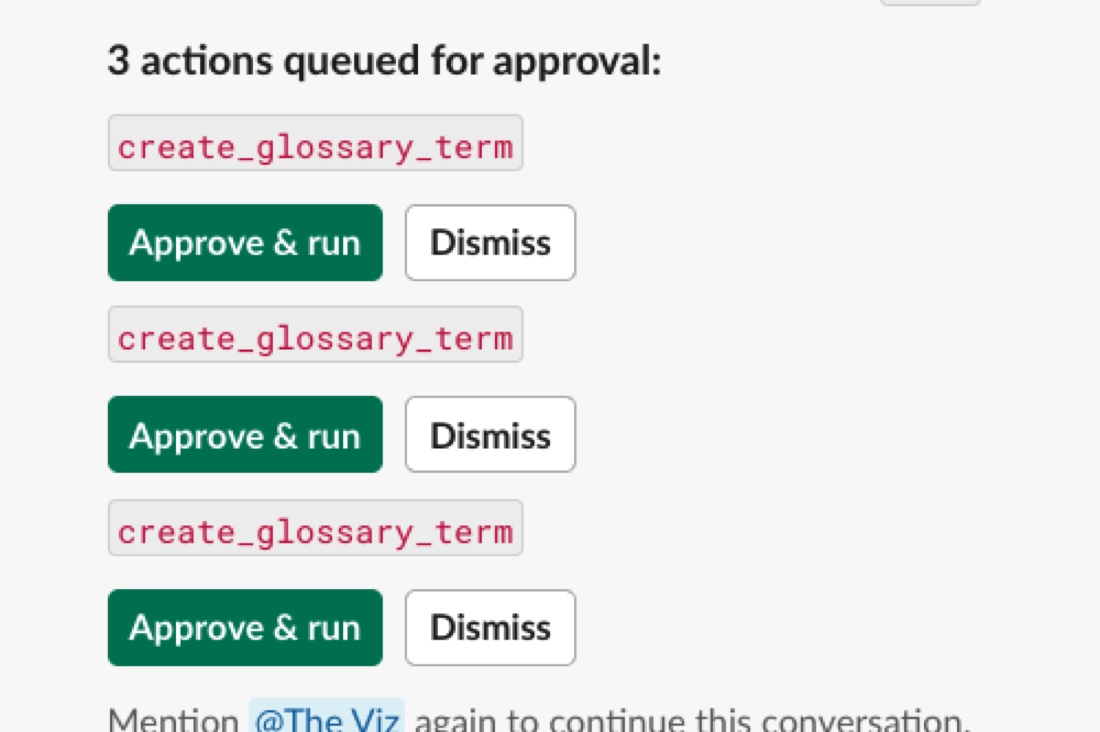
An agent that can silently redefine revenue is a liability, however good its answers are. The Admiral proposes, a human approves, and only then does the new definition become the answer everyone gets. That is the difference between putting an agent in a channel with eleven people in it and hoping for the best.
The whole point
Two teams. Two channels. One number.
Marketing asks on Monday. Finance asks on Thursday, in a different channel, in different words. Both get the same figure, because both answers resolve through the same approved definition rather than being worked out from scratch.
"What was CAC last month?"
"Customer acquisition cost, last month?"
CAC paid spend divided by new customers acquired in
the month. Spend includes platform fees, excludes agency retainer.
Same answer, both channels
Ask any general assistant the same question twice and you get two plausible answers, because it works the definition out again each time. The Admiral looks it up. That is the entire difference, and it is why you can put it in front of a whole company.
What people actually ask it
Four questions that used to take a day.
Not "automate your workflows." These are the four things a team asks one person for, over and over, until that person stops getting anything else done.
"Why is revenue down?"
It splits the move rather than restating it: new customer revenue against returning, which segment carries the drop, and whether volume or order value moved. Then it says what it cannot tell you without another source.
"I need the board numbers."
The same four figures as last quarter, resolved through the definitions that were approved last quarter. If one of those definitions had changed in between, the answer says so instead of quietly using the new one.
"Meta says 4.1 ROAS. Is that real?"
It gives you both numbers and explains why they differ: what the platform counts, what the warehouse counts, and how many conversions appear in one and not the other. Both are correct by their own definition. Only one is bankable.
"What counts as an active customer here?"
The approved definition, who set it, when, and the reason they gave. A new hire finds out on day two what everyone else in the channel already knows, without booking time with anyone.
How it stays right
"Never guessing" is easy to say. Here is the mechanism.
It looks up the definition
What counts as revenue here. What a pipeline stage means. Which date field the business decided to measure from. The glossary is a real object your team owns, not a prompt.
It shows its work
The definition it applied, the query it ran, the table it read, and when that source last synced. You can check it without asking a human, which is the only kind of trust that scales past a few people.
It refuses
No source, no answer. It names the gap and what closing it would take. A confident wrong answer is the expensive kind, and it is the default nearly everywhere else.
Connected sources
Not three hundred tools. The ones that hold your numbers.
Breadth is easy to advertise and it is how an agent ends up confidently wrong about a figure that goes into a board deck. Every source below is modelled, defined and tested before The Admiral is allowed to answer from it. If you need one that is not here, it gets added the same way rather than guessed at.
-
 HubSpot
-
 Salesforce
-
 BigQuery
-
 Google Analytics
-
 Google Tag Manager
-
 PostHog
-
 Looker Studio
-
 Meta
Meta
-
 Google Ads
-
 TikTok
-
 Stripe
-
 Shopify
-
 Snowflake
-
 Amplitude
-
 Mixpanel
-
 Twilio
-
 Slack
Slack
-
 Claude
The part we are proudest of
It would rather say no.
Every other agent in this category is optimised to produce an answer. That is the wrong objective when the answer goes into a board deck.
Ask for margin on your top five products and, if cost of goods is not in the warehouse, you do not get a plausible number. You get told that COGS lives in an accounting system that is not connected, what is available instead, and what wiring it up would take. Nobody finds out the hard way that the margin figure was invented.
That is not a limitation we are apologising for. It is the reason the other answers on this page are worth anything.
Straight comparison
An AI coworker, or an accountable one.
Both live in Slack. The difference is what happens when the answer matters.
| When you ask it | A general AI coworker | The Admiral |
|---|---|---|
| The same question twice | Works it out again. Two plausible answers. | Looks up the definition. Same answer. |
| Where the number came from | Describes its reasoning. | Shows the definition, the SQL, and the table it read. |
| Something it cannot source | Answers anyway, confidently. | Refuses, and names the missing source. |
| To change a definition | Remembers it for you, quietly. | Queues it for a person to approve, then applies it everywhere. |
| In a different channel | Fresh context, fresh assumptions. | Same glossary. Same answer. |
| How many tools it reads | Hundreds, out of the box. | Only the ones modelled and tested. On purpose. |
Getting started
Three steps, and the third one is ours.
-
The Admiral goes into your Slack
One install, into the workspace you already run. It starts in a single channel so you can watch it work before anyone else has to.
-
Anyone mentions it
No syntax, no query language, no dashboard to learn. People ask the way they would ask a colleague, in the channel where the decision is already happening.
-
We define the metrics with you
This is the part nobody else does, and it is why the answers hold. Your definitions get written down once, with the reasons attached, and The Admiral answers from them.
Questions
Is this just a chatbot on our data?
No, and the difference is the part that matters. A chatbot works out what a metric means every time you ask, which is why the same question gets two plausible answers on two days. The Admiral looks the definition up in your metric glossary before it answers, and tells you which one it used. Same question, same answer, until somebody changes the definition on purpose.
Can it change a definition on its own?
No. It can propose one. Ask it to commit something to memory and the change is queued as an action a person has to approve before it becomes the answer everyone gets. That approval step is why a governed agent is safe to put in a channel with eleven people in it, and it is the step a general purpose assistant skips.
What happens when it does not know?
It says so. If a question needs a source that is not connected, The Admiral names the missing source and what it would take to add it, rather than estimating. Margin is the usual example: it needs cost of goods, and cost of goods normally lives in an accounting system nobody has wired up yet.
Who can see the answers?
Whoever is in the channel. That is deliberate. The failure we are solving is one person holding an answer in a private chat with assumptions nobody else can check, so The Admiral answers in the open and shows its working every time.
How many tools does it connect to?
Fewer than you have been offered elsewhere, on purpose. Every source it answers from is modelled, defined and tested first. Breadth is easy to sell and it is how an agent ends up confidently wrong about a number that goes into a board deck.
Do we need the Data OS to use it?
Yes. The Admiral is how you reach the governed layer, not a replacement for it. The definitions, the warehouse and the tracking underneath are what make the answers hold, so it comes with the engagement rather than as a bolt on.
Bring the number your team argues about the most.
We will show you The Admiral answering it on your data, not ours, and tell you straight what it would take to make that answer hold every time. Thirty minutes, no pitch.
Get The Admiral in your Slack See the Data OS
The Admiral comes with the Data OS. The governed layer is the product. The Admiral is how you reach it.
Keep looking around
The Data OS
The full tour — what it is, what you get, and how engagements work.
Take a look →Why we built it
Most teams don't have a data problem — they have a trust problem.
Take a look →See an example
Four live dashboards you can filter and sort, with every number defined and queryable through your MCP.
Take a look →Ask it anything
Four questions, five people who can't answer them, and one system that can. Play the demo.
Take a look →Who runs what
Fully managed by Vision Labs, or run by your team. Drag the blocks and set the split.
Take a look →Security & Trust
Encryption, tenant isolation, least privilege, audit — the posture IT will ask about.
Take a look →For your boss (and IT)
The forwardable one-pager that gets you sign-off, with a copy-paste email.
Take a look →